/
/

Reading time:
7 min
Investing money explained briefly and clearly – for beginners and investment professionals
Have you ever asked yourself how the profit from investing money actually comes into being? And how does investing in Switzerland work in general? You’ll find the answers here.
THE MOST IMPORTANT POINTS AT A GLANCE:
Long-term appreciation + regular returns = your profit
So if you invest your money for the long term, you benefit from long-term appreciation on the one hand and regular returns on your investments on the other. In this way, you virtually secure your fair share of global economic success.
Index
How you can invest money
Investing money means using it to buy shares, bonds, real estate, gold, other commodities, cryptocurrencies, art or expensive wine. At findependent, however, we focus on investments in:
Equities
Bonds
Real estate
You want to invest money in Switzerland or abroad? With findependent you do not invest directly in shares, bonds and real estate, but use exchange-traded funds, so-called ETFs. They are inexpensive and allow you to invest broadly even with little money. This makes it easier for beginners to invest money with ETFs.
Profit from regular returns with investments
Investments in shares, bonds and real estate generate regular income, which you receive as the owner of these investments. Your invested money thus works for you. Whether you are a beginner or an expert – you don’t need to do anything else.
Investing money: What determines the price of investments
ETFs – like normal shares and bonds – can be bought and sold on the stock exchange on an ongoing basis. The price depends on supply and demand. For every buyer there is also a seller. So if more people want to buy an ETF than there are sellers on the other side, the purchase price will rise until the same number of people want to buy and sell and the market is in balance again.

But enough macro-economics 1.0, all you really need to know are the following two lines:
Number of buyers > Number of sellers ⟶ increasing prices
Number of buyers < number of sellers ⟶ decreasing prices
Investing money: Why fluctuations in value occur and are completely normal
How many people want to buy or sell depends strongly on current news and future prospects. Basically, if the forecasts are good, everyone wants to buy, if it looks bad, people are more cautious. But prices on the financial markets do not always reflect the real economic situation. A good example is the Corona crisis in 2020, in which general economic growth fell sharply worldwide, but prices recovered quickly and rose even during the crisis.
But market developments themselves also have an influence on investor behaviour: if a share rises strongly, it seems attractive and more people want to buy it. This leads to the price of the share rising further and even more people wanting to buy it. This continues until the first people start to sell the share again because they know that the price is actually much too high. The price starts to fall and now everyone wants to sell and the price falls even more.
These self-reinforcing cycles take place not only in individual stocks but also in the market as a whole and regularly lead to boom phases followed by corrections. Investment prices therefore often fluctuate in waves over several years.
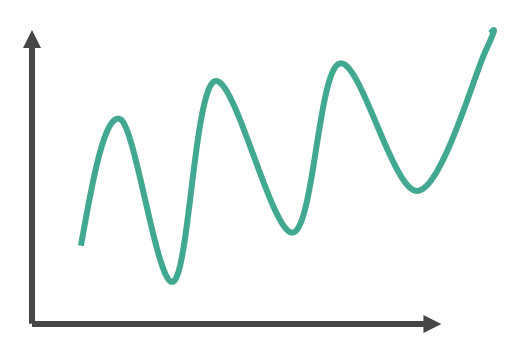
Fluctuations in the value of investments are therefore part of investing. Knowing this ultimately also helps to deal well with the fluctuations in one’s own investment solution. But especially when buying investments, it is difficult not to pay too much attention to the fluctuations and not to be distracted by the current market situation. It helps to automatically make regular payments into the investment solution with a standing order instead of actively reacting to any news. If you manage to endure the fluctuations and stick to your investments in the long term, you will almost certainly profit from them.
Why it pays to invest especially in the long term
Stock prices in particular rise significantly in the long term, as the chart of the Swiss stock market clearly shows.
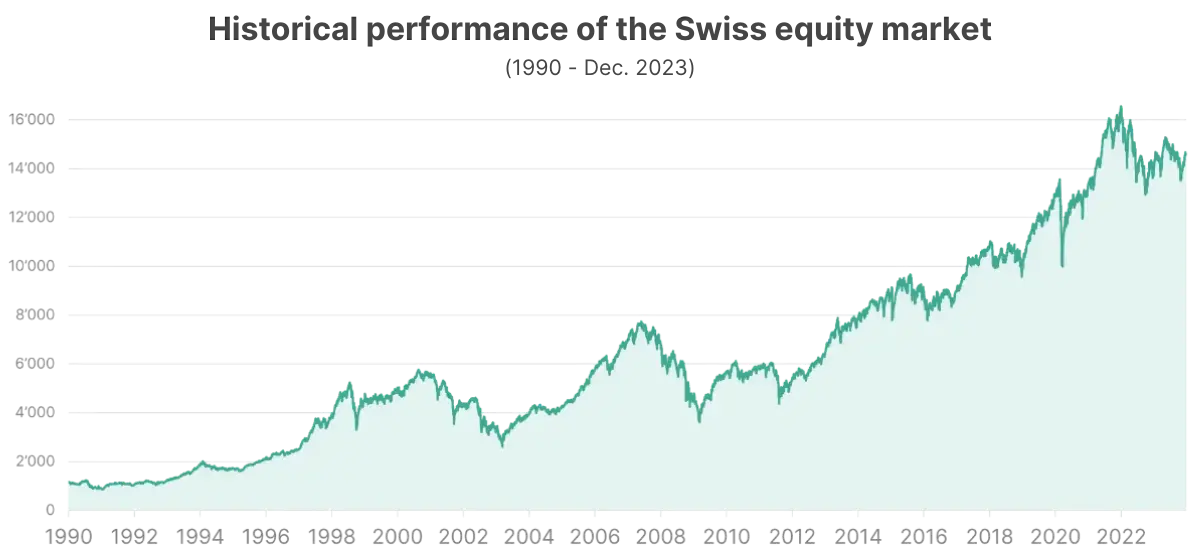
This is because companies always pay out only part of the profit as dividends and reinvest the rest to achieve higher profits in the future. Population growth as well as technological progress mean that the global economy grows in the long term and companies thus achieve higher profits. This in turn leads to rising share prices. Real estate is also tending to become more expensive, especially in Switzerland, because land is becoming increasingly scarce.
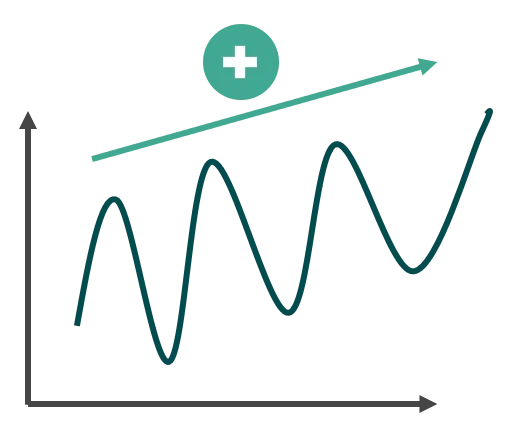
If you hold your investments for a longer period of time, you pursue a so-called “buy and hold” investment strategy and profit from the increase in value of your investments. In contrast, daily trading is a zero-sum game with winners and losers, where you hope to hit the “right” times and quickly run the risk of speculating.
Long-term appreciation + regular returns = your profit
So if you invest your money for the long term, you benefit from long-term appreciation on the one hand and regular returns on your investments on the other. In this way, you virtually secure your fair share of global economic success. And because we at findependent are convinced that everyone should benefit from this success, we have set ourselves the goal of making investing simpler and easier to understand and thus making the associated advantages accessible to everyone.